

THE HAKKA JOURNAL
Commercial Toaster Browning Settings: Organize Mixed Orders
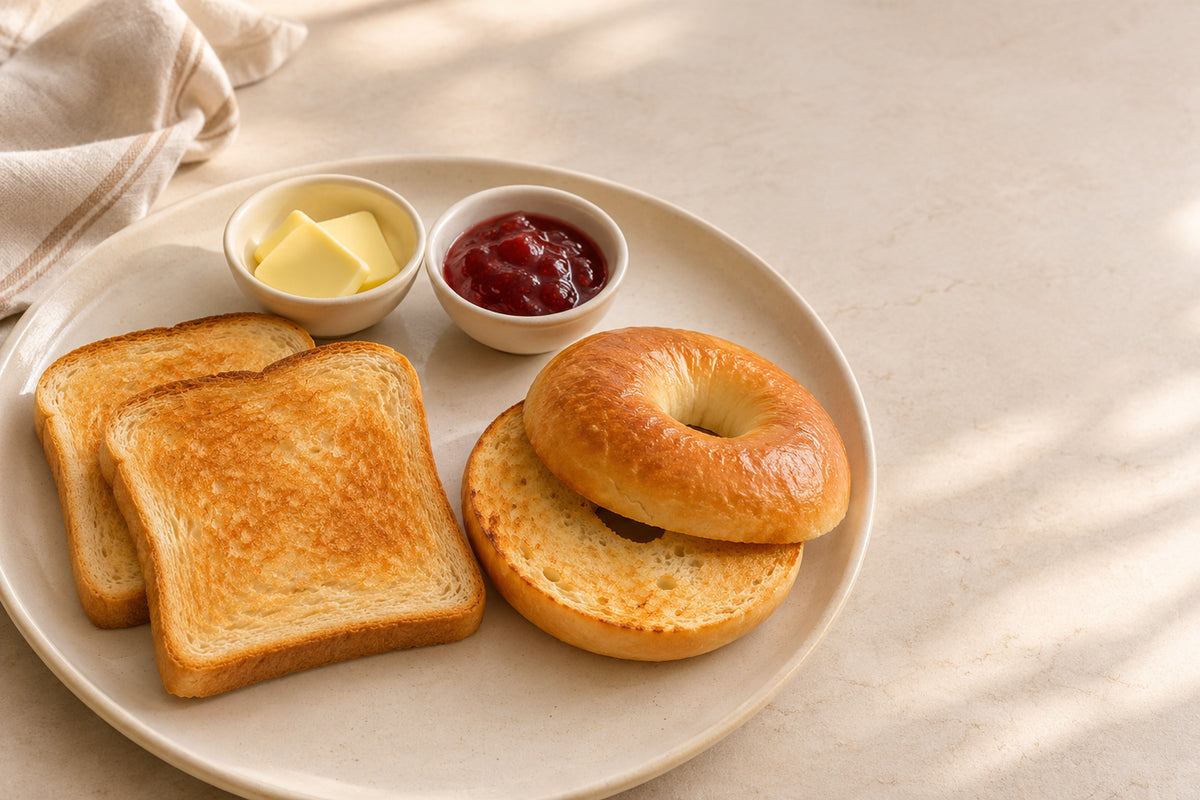
Commercial toaster browning settings are easier to manage when staff connect each setting to the bread being served. White sandwich bread, wholegrain slices and bagel halves are different menu items; one familiar dial position should not become a promise of identical results for all three.
For a breakfast counter handling mixed orders, the useful question is how to record and repeat the result you want. Here is a practical approach, using the Hakka FT-03 four-slice commercial toaster as a product reference. For equipment selection rather than daily settings, see our commercial toaster buying guide.
Match commercial toaster browning settings to the bread
Different bread types can require different browning settings. A useful station record identifies the exact bread product, its usual slice format and the desired finish. A note that says only “toast” leaves too much to interpretation when the menu includes several breads.
Keep the comparison simple: assess one bread product at a time while following the toaster's instructions. Record what was loaded and which controls were used. If you change both the bread and the setting together, it becomes harder to understand why the result changed.

Check that the item fits the model's permitted loading requirements. A slot-width specification is a buying reference, not a reason to force in an awkward slice. Follow the supplied operating guidance for the exact model and suitable foods.
Use the FT-03's independent control pairs deliberately
The current Hakka FT-03 listing describes four slots split into two independently controlled pairs, six browning levels, automatic pop-up operation and an 1800W heating system. It also lists 1.5-inch extra-wide slots, self-centering racks, a high-lift lever and two removable crumb trays.
The independent pairs give staff a way to keep different settings separate during mixed orders. For example, you can organize one pair around one bread choice and the other around another, using settings established for your own menu and the manufacturer's directions. Make the arrangement clear to the next person working at the station.
This is an order-organization approach, not a fixed setting chart for the FT-03. We are not assigning a universal dial number to white bread, wholegrain bread or bagels. Your chosen finish and the actual bread product still need to be checked.
Build a short record staff can actually use
| Record | Example of what to note |
|---|---|
| Bread identity | The supplier's bread name or your kitchen's item description. |
| Slice format | The usual slice or prepared half used on the menu. |
| Control pair | Which independently controlled pair is assigned to the order. |
| Setting and finish | The setting used and the appearance accepted for service. |
| Change to review | A different bread delivery, cut or customer preference. |
Keep the record near the order information without obstructing the appliance or its required clearances. When a bread product changes, review the associated note instead of assuming the previous setting will carry over unchanged. Do not transfer a starting-setting number from another brand's manual to this model.

Plan collection, plating and routine care
Leave an appropriate place for finished orders and the next plating step. A toaster's cycle is only one part of breakfast service: staff still need to collect the food, match it to the order and move it onward. Keep those steps distinct from the loading area so the next order does not become confused with the last.
Include the product's normal cleaning and inspection requirements in the station routine. The FT-03 listing identifies removable crumb trays; use the supplied instructions for shutdown, cooling, tray removal and cleaning rather than borrowing a method for a different toaster. If food jams or a control does not operate normally, stop use and follow the model's guidance or contact support.
Breakfast-service checklist
- Identify the bread: distinguish each bread choice and its usual slice format.
- Confirm permitted loading: check the exact product instructions and fit.
- Keep the pairs clear: record which independent controls are being used for each order.
- Record the accepted finish: avoid relying on a remembered dial number without a bread reference.
- Review changes: reassess the note when the bread product or serving preference changes.
- Plan the handoff: leave a usable collection and plating area and follow the routine care instructions.
Frequently asked questions
Which setting should I use for every bread?
There is no single setting we can recommend for every bread and preference. Follow the model's operating instructions and establish a record for the actual bread you use. Settings from another appliance are not a model-specific recipe.
Can the Hakka FT-03 use different settings at the same time?
The current listing describes two independently controlled pairs of slots. This supports organizing different settings across the two pairs; confirm the operating details in the supplied instructions.
Do extra-wide slots mean there is a dedicated bagel mode?
Not by themselves. Slot dimensions describe a physical feature. Check the exact model's controls and instructions before expecting a dedicated bagel or one-sided toasting function.
Where can I review the product details?
See the current Hakka FT-03 four-slice toaster listing for the listed controls and features. For broader station planning, our article on reducing kitchen prep bottlenecks covers how individual tasks fit into the rest of service.
Keep exploring
All guides ↗
Choosing the Right Smoker Oven for Restaurants
Choose a smoker oven for restaurants with the capacity, temperature control, recovery time, and build quality needed for consistent commercial service.
Read the guide
Pizza Peel Size: Check the Head, Reach and Workspace
Choose a pizza peel by checking the working head, assembled reach, and station space. Review two Clivia detachable-handle options and a practical buying checklist.
Read the guide
Best Equipment for Burger Kitchens That Perform
Choose the best equipment for burger kitchens with practical guidance on griddles, refrigeration, prep, frying, holding, and workflow capacity planning.
Read the guide
Join the conversation