

THE HAKKA JOURNAL
Blast Chiller vs Freezer: Which Does Your Kitchen Need?
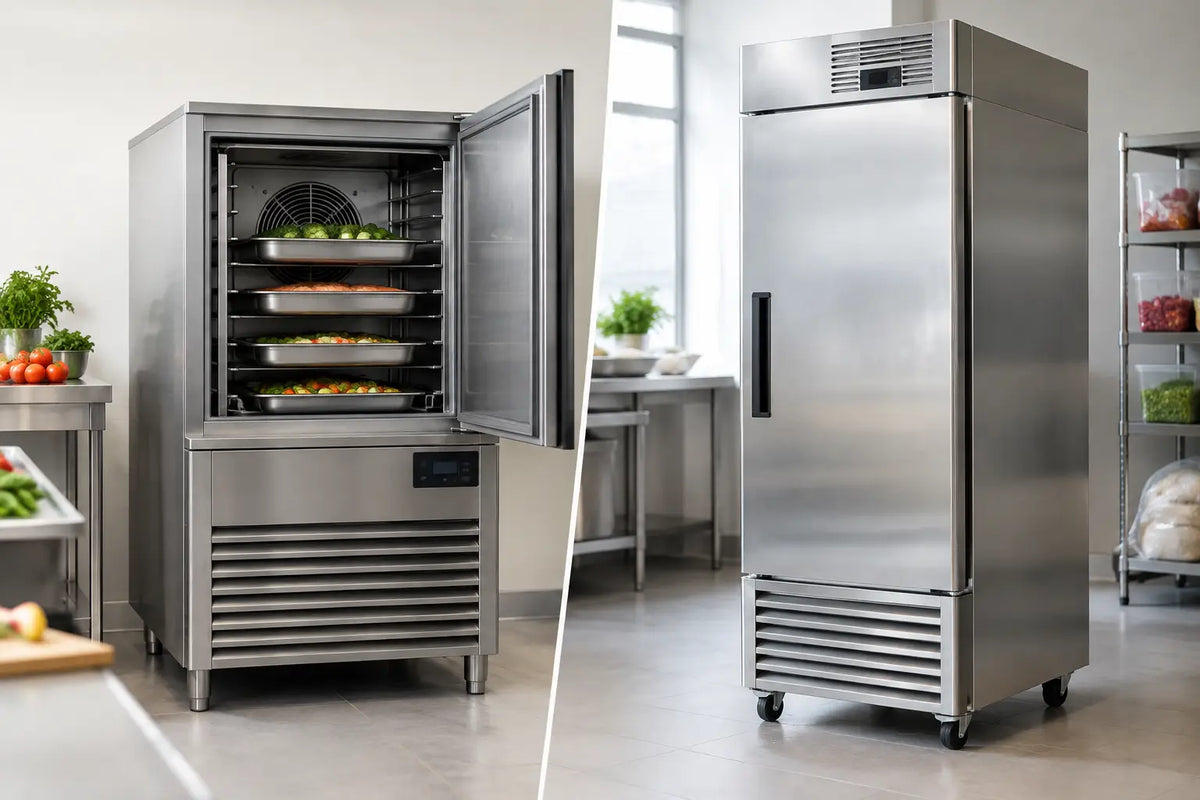
A standard freezer can hold food below freezing for long-term storage. It is not designed to pull heat out of a full pan of hot chili, a rack of smoked brisket, or a batch of cooked sausage quickly. That is the practical difference in a blast chiller vs freezer decision: one protects a finished product during rapid cooldown, while the other preserves product after it is already cold.
For restaurants, butcher shops, bakeries, caterers, and BBQ operations, choosing the wrong machine can create a bottleneck in production. It can also affect food safety procedures, texture, yield, storage capacity, and the number of labor hours required to prep ahead.
What a Blast Chiller Does
A blast chiller uses high-velocity, extremely cold air to remove heat from food much faster than a reach-in or walk-in freezer. Operators commonly use it to bring hot cooked food down through the temperature danger zone quickly, then move the chilled product into refrigerated storage or freeze it for later service.
The equipment is built for active cooling, not just cold holding. Powerful refrigeration components, forced airflow, insulated cabinet construction, and programmable digital controls work together to cool product evenly. A commercial blast chiller may offer chilling and hard-freezing cycles, probe controls, timer controls, adjustable setpoints, and rack capacity suited to hotel pans, sheet pans, bakery trays, or food-processing containers.
This process matters when production is measured in batches. A commissary may cook several gallons of sauce in the morning. A butcher may smoke, cook, or par-cook sausage before packaging. A bakery may need to cool filled pastries, mousse cakes, or laminated dough without compromising their structure. In each case, rapid cooling creates a more controlled handoff between cooking, packaging, storage, and service.
What a Commercial Freezer Does
A commercial freezer is primarily a storage machine. It maintains frozen inventory at a stable temperature, usually around 0°F or below depending on the operation and local requirements. Upright freezers, chest freezers, undercounter units, and walk-in freezers are all designed to hold product after freezing and protect it from thawing during normal use.
A freezer can eventually freeze many foods, but its cooling rate changes based on cabinet load, airflow, product thickness, starting temperature, and how often the door opens. Loading hot food into a standard freezer can warm the cabinet, put pressure on the refrigeration system, and expose nearby frozen inventory to temperature fluctuation.
That does not make a freezer less necessary. Most operations need dependable frozen storage for proteins, prepared items, dough, desserts, fries, and backup inventory. The key is understanding that storage capacity and rapid pull-down capacity are different equipment functions.
Blast Chiller vs Freezer: The Operating Differences
The most useful comparison is not whether one unit gets colder than the other. It is what happens to product during the first hour after cooking or preparation.
A blast chiller is designed to move large amounts of heat out of food quickly. High-speed air circulation reaches the surface of pans and trays, while colder cabinet conditions support faster heat transfer. This helps operators cool products in a controlled cycle instead of leaving them at room temperature or overloading a refrigerator.
A freezer operates more gradually. Its purpose is to maintain a frozen environment, often with less aggressive airflow and no expectation that operators will load it with a high volume of hot product. It works well for packaged frozen goods and properly cooled products headed for extended storage.
The difference shows up in product quality as well. Rapid chilling can reduce moisture loss, protect color, and limit the formation of large ice crystals when products are frozen quickly. Smaller ice crystals generally mean less cell damage, which can improve texture and reduce purge after thawing. This is especially valuable for seafood, portioned meats, sauces, bakery products, and prepared foods sold in frozen form.
Food Safety Is a Workflow Issue
Cooling is not only an equipment question. It is a workflow question that begins when food comes off the range, smoker, oven, kettle, or grill.
Foodservice operators must follow applicable FDA Food Code guidance and local health department requirements for cooling time and temperature. A blast chiller can support a compliant cooling process, but it does not replace staff training, proper pan depth, accurate temperature checks, labeling, or written procedures. Dense products still need to be portioned appropriately, and cabinet capacity must not be exceeded.
For example, a deep stockpot of soup cools slowly even in a cold environment because heat is trapped at the center. Dividing the soup into shallow pans before blast chilling improves results. The same principle applies to braised meats, rice, gravy, cooked beans, pulled pork, and thick sauces.
A standard freezer should not be treated as the default answer for cooling hot food. Beyond the risk of warming stored inventory, it can create inconsistent results when the cabinet is loaded beyond its ability to remove heat. If rapid cooling is part of daily production, purpose-built equipment gives the kitchen a more repeatable process.
When a Freezer Is the Right Choice
Choose a commercial freezer when your main need is stable, long-term frozen storage. A freezer is usually the better investment for an operation that receives frozen ingredients, holds prepackaged products, or needs additional inventory space without producing large volumes of hot prepared food.
It is also the practical choice when products are already chilled before freezing. For a small restaurant storing frozen proteins, fries, desserts, and purchased prepared items, an upright or chest freezer may solve the immediate capacity problem at a lower equipment cost.
Consider the physical workflow. Freezers are available in many footprints and capacities, from compact undercounter models to large walk-ins. They are built for organization, product rotation, and routine access. If staff need to retrieve cases of product throughout the day, a freezer with the right shelving, door style, and interior layout may provide more operational value than a blast chiller.
When a Blast Chiller Earns Its Space
A blast chiller makes sense when cooling speed affects your ability to produce, package, store, or safely serve food. It is particularly useful for operations that cook in bulk, prep several days ahead, or sell high-value products where texture and yield matter.
Butcher shops and meat processors can use rapid chilling to firm cooked or smoked products before slicing, packaging, or freezing. BBQ operators can cool prepared meat efficiently before portioning and cold storage. Caterers can build menus ahead of events, cool prepared components under control, and reheat in organized batches. Bakeries can stabilize delicate products more quickly and create a more predictable production schedule.
A blast chiller can also improve labor planning. Instead of running smaller batches because cooling capacity is limited, a kitchen can produce in larger, planned runs. That can reduce repeated setup, support centralized prep, and free up refrigerated storage for ingredients and ready-to-serve products.
Size the Equipment for Your Actual Production
Do not size a blast chiller by the number of employees or the size of the dining room. Size it by the maximum amount of hot product that must be cooled during a defined production window. Review the weight of the product, pan type, pan depth, starting temperature, target temperature, and number of batches per day.
For freezers, calculate the cubic space required for peak inventory, then account for shelving, air circulation, product rotation, and future volume. A freezer packed wall to wall may hold more cases on paper, but poor airflow and difficult access cost time during service.
Before buying either unit, verify electrical requirements, overall dimensions, door swing, ventilation clearance, drainage needs, and available rack or pan compatibility. For blast chillers, review the temperature range, chilling and freezing capacity, probe options, cycle programming, and the manufacturer's stated performance conditions. For freezers, focus on storage volume, compressor duty, defrost system, door configuration, insulation, and temperature recovery after frequent openings.
The Best Setup Is Often Both
For many professional kitchens, this is not an either-or purchase. A blast chiller handles the critical cooling stage, while a commercial freezer holds finished frozen inventory. Used together, they separate rapid production work from long-term storage and reduce stress on both pieces of equipment.
If budget or floor space requires one purchase first, start with the bottleneck. Buy freezer capacity when frozen inventory is crowding the operation. Buy blast chilling capacity when hot food cooling delays prep, creates inconsistency, or limits batch production. The right equipment is the unit that removes the constraint your team faces every day.
Keep exploring
All guides ↗
How to Reduce Prep Bottlenecks in Busy Kitchens
Reduce prep bottlenecks with workflow design, right-sized equipment, cold storage, and station planning that keep commercial kitchens producing daily.
Read the guide
Salad Spinner Not Drying Lettuce? Check Your Batch
Troubleshoot unevenly wet greens with practical loading, drainage and workflow checks, plus a fact-based comparison of Clivia 10 Qt and 20 Qt manual spinners.
Read the guide
Buffet Drink Station Setup: Cups, Clearance and Refills
Plan a buffet drink station around cup clearance, guest flow and refill access, with practical checks for Hakka 3-gallon and 5-gallon dispensers.
Read the guide
Join the conversation